How Community Nursery Buyback Schemes Could Support Restoration
When communities grow planting material locally and programs buy it back for restoration work, participation, skills, and supply can align—without treating people only as recipients of seedlings.
One of the biggest weaknesses in many restoration efforts is that communities are often treated mainly as recipients.
Seedlings arrive. A planting day happens. A project is launched. And then, after a short burst of activity, the real question appears:
Who actually carries this forward from here?
That is why community nursery buyback schemes are so interesting.
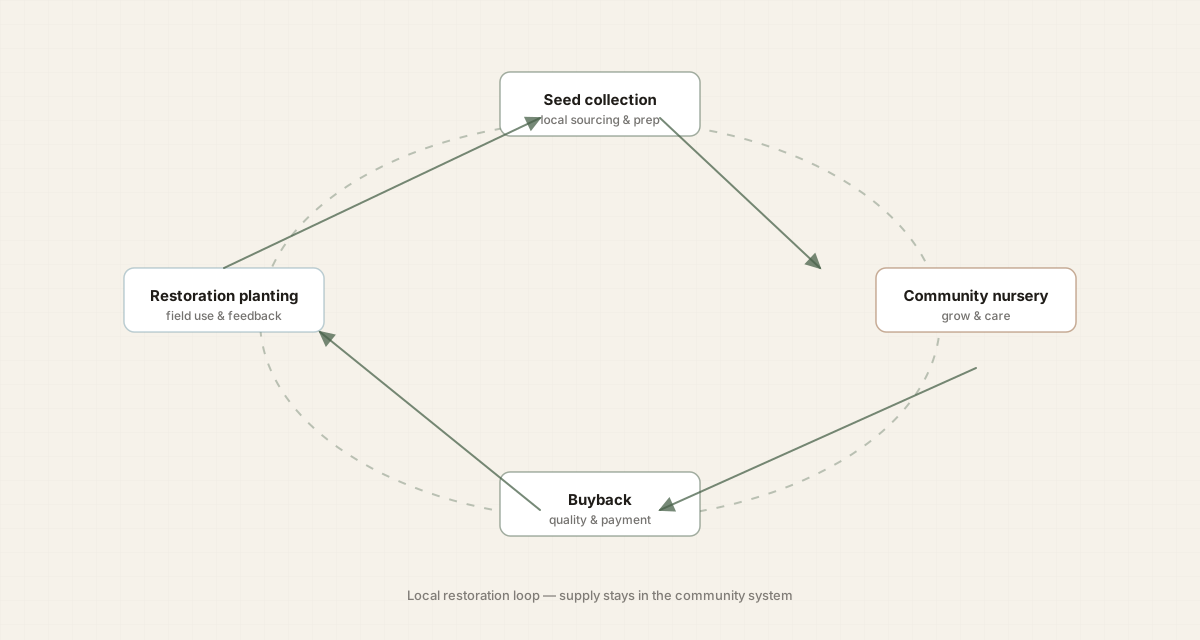
Instead of only delivering seedlings into a community, the idea is to support people to grow the planting material themselves — and then buy it back from them as part of a wider restoration effort.
That changes the model in a meaningful way.
Now the community is not just receiving a restoration program. It is participating in it. Learning from it. Building local growing capacity through it. And, in some cases, earning from it.
That is what makes this approach worth taking seriously.
The basic idea
A community nursery buyback model is fairly simple at its core.
The idea is to:
- introduce nursery skills and basic seedling care
- support local people or groups to raise seedlings
- provide some structure around what types of seedlings are needed
- buy healthy seedlings back for use in restoration work
- create an ongoing local supply pathway for planting efforts
That could be done at different scales.
For example:
- a small village nursery
- several growers in one community
- women’s groups or youth groups raising seedlings
- household-level nursery efforts feeding into a shared buyback model
- local nursery clusters linked to a wider restoration program
The point is not only seedling production. The point is to create a local restoration loop.
Why this matters for restoration
A lot of restoration projects struggle with a basic supply problem: how do you consistently get the right planting material, in the right condition, at the right time?
If everything comes from outside, that can create a number of issues:
- higher transport burden
- less local ownership
- weaker understanding of what is being planted
- less flexibility around timing
- less involvement from the community itself
- limited continuity once the initial project ends
A buyback model helps shift some of that.
Now restoration can begin to draw from:
- local growing effort
- local plant familiarity
- local participation
- local nursery experience
- a more distributed production model
That does not solve everything. But it can make restoration feel less like an outside event and more like something rooted in the place itself.
The indirect education value is one of the biggest strengths
One of the most important parts of this model is not only the seedlings.
It is the learning that happens around them.
When people are involved in nursery work, they begin to engage with restoration differently.
They learn things like:
- how seedlings develop
- what different species need
- how fragile early growth can be
- why timing matters
- why watering and protection matter
- why survival is not automatic
- how much effort it takes to get a plant established well
That kind of learning is valuable because it is not only theoretical.
It is practical, repeated, and tied to daily care.
In other words, the buyback model can create a form of indirect environmental education.
Not by giving a lecture first, but by involving people in the process itself.
That often teaches more deeply than awareness campaigns alone.
This turns restoration into participation, not just distribution
There is a big difference between:
- handing out seedlings and
- helping communities grow them
In the first model, people may still appreciate the effort, but the restoration logic stays fairly external.
In the second model, people become part of the chain.
That can help create:
- stronger ownership
- better understanding of why the seedlings matter
- more interest in what happens after planting
- a clearer connection between local effort and restoration outcomes
- more durable participation over time
This is one reason buyback schemes are so attractive. They do not just distribute materials. They help create a role for communities within the restoration system.
Why the buyback part matters
The buyback part is important because it creates a more practical incentive structure.
Without it, nursery participation may depend mostly on goodwill, extra time, or uncertain future benefit.
With a buyback model, there is a clearer pathway:
- grow seedlings
- care for them to a usable standard
- have them reviewed or accepted
- receive payment or compensation when they are bought for restoration use
That creates a more tangible reason to participate.
It also helps frame restoration as something that can support:
- local effort
- local livelihood pathways
- local enterprise
- local stewardship
That does not mean the model should be treated as a pure commercial system. But the buyback mechanism helps anchor the work in something practical rather than symbolic.

This could be especially useful for youth and women’s groups
A nursery buyback approach can also create room for different kinds of local participation.
For example, it may be particularly useful for:
- youth groups
- women-led growing groups
- local cooperatives
- school-linked growing programs
- small household nursery efforts
That matters because restoration should not only be about environmental outcomes in isolation.
It can also be about:
- building local roles
- creating practical skills
- supporting small-scale economic participation
- strengthening long-term involvement in land recovery
A nursery is not just a technical unit. It can also become a social and learning space around restoration.
It helps build local capability over time
Another big advantage of this model is that it builds capacity that stays behind.
If a community learns how to:
- raise seedlings well
- recognize healthy planting stock
- think about species selection
- organize local nursery work
- track basic nursery progress
- connect production to actual planting demand
then that knowledge does not disappear when one planting cycle ends.
That is important because one of the biggest weaknesses of project-based restoration is that too much capacity sits outside the community.
A buyback nursery model starts to reverse that.
Now the community holds more of the practical knowledge:
- how to grow
- what survives
- what timing matters
- what quality looks like
- how restoration supply works
That is valuable even beyond the first program.
It can also improve restoration quality — if designed well
There is a practical quality benefit here too.
If nursery systems are local and repeated, they can improve the chances of:
- better handling
- fresher planting stock
- stronger adaptation to local timing
- more familiarity with what species do well
- more continuity between nursery production and planting needs
But that only happens if the model is designed with some care.
Because not every buyback system will automatically produce strong outcomes.
The program still needs to think about:
- what species should be encouraged
- what quality standards are reasonable
- what “ready for planting” actually means
- how seedlings are reviewed
- how transport or handover happens
- what survival feedback is given afterward
So the model has to be practical, not just optimistic.
A simple buyback scheme is often better than an overbuilt one
This is important.
It is easy to imagine a complicated system with:
- detailed contracts
- advanced nursery management tools
- formal payment systems
- extensive species tracking
- multi-step quality approval processes
Some of that may make sense later.
But in many contexts, the better starting point is a much simpler model.
For example:
- a small set of priority species
- basic training
- simple nursery guidance
- a few agreed quality checks
- fixed buyback windows
- straightforward record-keeping
- small-scale first rounds to learn what works
That is often enough to start building a real system without making it too heavy.

What this could look like in practice
A realistic pilot might look something like this:
- select one village or local group
- identify a small number of useful species
- provide basic nursery training and starter support
- set a clear buyback model for accepted seedlings
- define simple quality expectations
- review what is ready after a set period
- buy back seedlings for use in nearby restoration work
- track what gets planted and, where possible, what survives
That kind of pilot would not only test nursery production.
It would also test:
- interest
- consistency
- quality
- practical participation
- indirect learning
- whether the model feels worth continuing locally
Those are good questions to test early.
What this can teach a restoration program
A buyback nursery scheme is useful not only because it supplies seedlings.
It also helps answer broader questions such as:
- Which species are communities most comfortable growing?
- What level of support is needed?
- What kinds of nursery work are realistic locally?
- Which quality standards are too strict or too vague?
- How much interest is there in repeated participation?
- Does the model support stronger stewardship after planting?
In that way, the nursery becomes not just a supplier, but a source of learning for the whole restoration program.
Why this matters in Somalia
In Somalia, this kind of model could be especially useful because it links restoration with:
- local participation
- practical skill development
- small-scale livelihood opportunity
- in-country growing capacity
- more durable involvement in the restoration process
It also fits well with a broader principle: restoration is stronger when local people are not only recipients of materials, but active contributors to how the system works.
That is important in any place, but especially important in dryland settings where long-term stewardship and practical continuity matter so much.
Why this matters for Abuur Labs
At Abuur Labs, this kind of approach is interesting because it brings together several things we care about:
- restoration
- local capability
- practical education
- community participation
- systems that can actually hold over time
The nursery is not just about plants. It is about building a local restoration role.
And the buyback element makes that role more concrete.
Instead of asking people to care in the abstract, the system invites them into the work in a way that is practical, educational, and potentially economically meaningful.
That is a strong model worth exploring.
A better way to think about buyback schemes
So how should we think about a community nursery buyback model?
Not just as a procurement system.
And not just as a training exercise.
But as a way to make restoration more local by linking:
- seedling production
- practical learning
- local participation
- small-scale incentives
- and long-term stewardship
That is what makes it more than a side activity.
It becomes part of how restoration capacity is actually built.
Key takeaway
A community nursery buyback scheme can support restoration not only by producing seedlings locally, but by creating indirect environmental education, stronger participation, practical local skills, and a more grounded restoration supply system over time.